
The question: what were Disney’s future cash flows worth?
Disney brings together businesses with different economics: films and television, sports, streaming, and theme parks. For this project, I valued them together by asking how much cash the company could generate, and what that future cash was worth at the time of the analysis.
The assignment called for a complete Excel valuation: estimate the cost of capital, build projected financial statements, calculate five years of free cash flow, and arrive at a value per share. My workbook follows that sequence. The financial-statement tabs feed Assumptions, which feeds Pro Forma; Cost of Capital supplies the rate used to discount the forecast.
1. Start with revenue, then build the business around it
I used FY2025 revenue of $94.425 billion as the starting point. To set a growth assumption, I compared it with $65.388 billion in FY2020. Those six annual observations span five growth periods:
Annual growth = (94,425 ÷ 65,388)^(1/5) − 1 = 7.63%
That is a compound annual growth rate: the steady annual pace that connects the two endpoints. Applying it to each previous year’s sales takes revenue to $101.6 billion in Year 1 and $136.4 billion in Year 5.
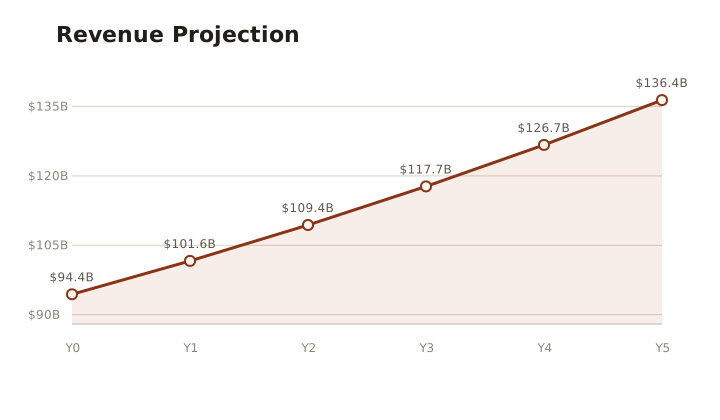
I used this historical pace as the base-case growth assumption for Disney as a whole. It provides a consistent starting point for the forecast; segment-specific growth and alternative starting periods would be useful scenario extensions.
How I estimated operating costs
For most operating assumptions, I calculated a ratio for each of FY2023, FY2024, and FY2025, then averaged the three ratios. I averaged the annual percentages rather than dividing the combined costs by combined revenue.
| Driver | How I calculated it | Forecast assumption |
|---|---|---|
| Cost of goods and services | Product and service costs ÷ revenue | 64.4% of revenue |
| SG&A | Selling, general, and administrative expenses ÷ revenue | 17.3% of revenue |
| Capital spending | Investments in parks, resorts, and other property ÷ revenue | 6.7% of revenue |
| Operating current assets | Receivables, inventories, content advances, and other current assets ÷ revenue | 20.5% of revenue |
| Operating current liabilities | Payables, accrued liabilities, and deferred revenue and other ÷ revenue | 29.9% of revenue |
For example, cost of goods and services was 66.6%, 64.2%, and 62.2% of revenue in 2023, 2024, and 2025. Their average becomes the 64.4% assumption. In Year 1, that means approximately $65.4 billion of costs on $101.6 billion of revenue.
Averaging smooths out individual years, but it also gives up some recent improvement: the model assumes a higher cost ratio than Disney reported in 2025.
Workbook reference: Assumptions, rows 3–10, 15–29, 55–65, and 77–79. Financial figures are in millions of dollars unless noted otherwise.
2. Account for reinvestment, working capital, and taxes
Capital spending and depreciation
Capital spending is the cash invested in long-lived assets. Depreciation is the accounting expense that spreads their cost over time. The model needs both because they affect cash flow differently.
Disney’s capital spending was $5.0B in 2023, $5.4B in 2024, and $8.0B in 2025. Averaging each year’s spending-to-revenue ratio gives 6.67%, or $6.78B in forecast Year 1. That is below 2025 spending: the forecast returns to the historical average rather than extending the latest investment level.
For depreciation, I divided depreciation and amortization from the cash-flow statement by the previous year’s gross attractions, buildings, and equipment. The two available ratios—6.95% for 2025 and 7.12% for 2024—average to 7.03%. Applied to 2025 gross property of $82.04B, this produces $5.77B of Year 1 depreciation. This uses a historical depreciation-and-amortization proxy, with prior-year gross property as the forecasting base, rather than separate useful-life schedules for each asset category.
Why working capital is negative
Here, working capital means operating current assets minus operating current liabilities. I excluded cash from the asset calculation and borrowings from the liability calculation, keeping financing separate from operations.
In 2025, that was $18.57B − $27.45B = −$8.88B. Payables, accruals, and deferred revenue exceeded the operating current assets included in the model. The forecast preserves that relationship using the historical ratios above.
By Year 1, working capital becomes −$9.48B. The additional $0.60B of operating funding increases free cash flow. It is the change in working capital, rather than its entire balance, that enters the cash-flow calculation.
Why I chose a 24% operating tax rate
Disney’s FY2025 effective tax rate was −11.9%, including an approximately $3.3B non-cash tax benefit related to Hulu’s change in U.S. tax classification. Carrying that negative rate into every forecast year would treat an unusual benefit as recurring.
I therefore entered 24% as a normalized forecast tax rate. This was a judgment call, not the historical average: the workbook’s three-year average was 13.6%, pulled down by 2025. For context, the reported 2024 effective rate was 23.7%.
Workbook reference: Assumptions, rows 31–32, 48–51, and 69–79. Annual-report reference: FY2025 10-K, “Effective Income Tax Rate” and Note 9, “Income Taxes.”
3. Translate the forecast into free cash flow
With these assumptions in place, I projected the income statement and balance sheet. Debt and several long-term assets stay constant; forecast profits accumulate in equity. Cash is the balancing item that makes assets equal liabilities plus equity, following the assignment’s approach.
The valuation then uses unlevered free cash flow: cash available to both lenders and shareholders, before financing payments.
FCF = EBIT × (1 − tax rate) + depreciation − capital spending − change in working capital
Here is how the first forecast year comes together:
| Year 1 calculation | Cash-flow effect |
|---|---|
| Operating profit of $12.84B, after 24% tax | $9.76B |
| Add back depreciation, a non-cash expense | +$5.77B |
| Subtract capital spending | −$6.78B |
| Add the benefit from more negative working capital | +$0.60B |
| Free cash flow | $9.35B |
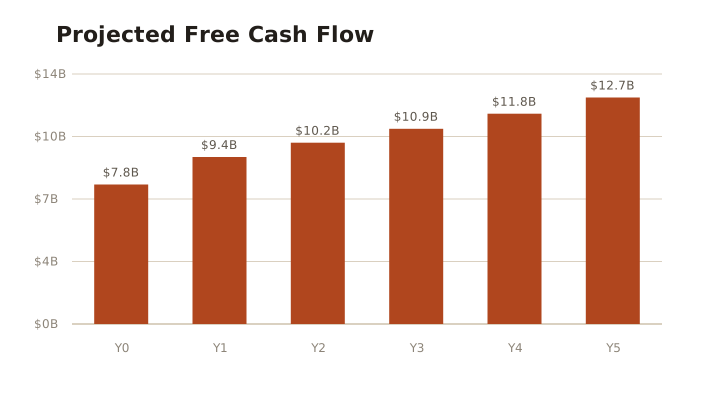
The first-year increase is not just a revenue-growth story. The move from 2025 capital spending to the lower historical-average spending ratio, together with working-capital funding, helps cash flow rise even though modeled operating profit falls initially.
Workbook reference: Pro Forma, rows 24–57 and 64–71.
4. Bring future cash back to present value
Where the 8.71% discount rate came from
The weighted average cost of capital, or WACC, combines the required return on equity with the after-tax cost of debt. A higher discount rate reduces the present value of the same future cash flows.
For equity, I used the capital asset pricing model:
Cost of equity = 4.017% + 1.49 × 3.73% = 9.57%
The workbook retains screenshots of the 4.017% 10-year Treasury rate, Yahoo Finance’s 1.49 five-year monthly beta, and Damodaran’s 3.73% implied equity-risk premium dated November 1, 2025. Beta scales the market risk premium to estimate Disney’s equity risk.
For debt, I used 6.4% as the borrowing-cost assumption. The FINRA screenshot saved in the workbook shows Disney bonds maturing on December 15, 2035, approximately ten years from the project date. Their 6.4% coupon provides the bond-rate proxy used in this classroom model.
Equity market capitalization of $187.83B and balance-sheet borrowings of $42.03B produce weights of 81.7% equity and 18.3% debt. The debt amount is a book-value proxy, rather than a separately estimated market value.
I apply the 24% normalized tax assumption to the debt tax shield as well as the operating forecast. This gives an after-tax borrowing cost of 4.864%:
After-tax cost of debt = 6.4% × (1 − 24%) = 4.864%
Weighting the cost of equity and after-tax debt cost by their shares of capital produces 8.71% WACC. The calculation uses the full-precision weights and rates from the workbook.
What happens after Year 5
Beyond Year 5, I assumed cash flow grows at 3% annually in perpetuity. This is a long-run modeling assumption, separate from the historical revenue-growth calculation. It slows growth from the explicit forecast and keeps it below the discount rate, as required by the perpetual-growth formula.
Terminal value = Year 5 FCF × (1 + 3%) ÷ (WACC − 3%)
The resulting value at the end of Year 5 is $228.65B. Discounting it back gives $150.58B; discounting the five explicit forecast cash flows gives another $42.48B.
Following the assignment, I then applied a midyear adjustment to their sum to reflect cash arriving throughout the year:
Enterprise value = ($42.48B + $150.58B) × √(1 + WACC) ≈ $201.30B
About 78% of this value comes from the terminal component when both components receive the same adjustment. That makes the discount rate and long-run growth assumption especially important to the conclusion.
Workbook reference: Cost of Capital, rows 3–20; Pro Forma, rows 74–81.
5. Move from business value to value per share
Enterprise value belongs to the providers of capital. To estimate the portion attributable to shareholders, the model subtracts debt and adds cash and investments:
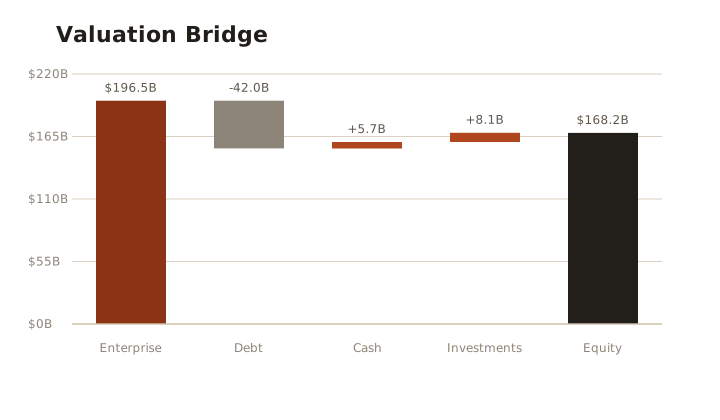
Dividing $173.06B by 1.799 billion shares gives $96.20 per share. The market capitalization and share count used in the model imply approximately $104.41 per share, putting my estimate about 7.9% below that comparison price. The $104.41 comparison price is implied by the project’s $187.83B market capitalization and 1.799 billion shares; it is a historical benchmark, not a current quote.
Workbook reference: Pro Forma, rows 83–89; Cost of Capital, cell B16.
Modeling scope
- Consolidated Disney forecast using historical ratios, with net fixed assets at 41.18% of revenue and cash as the balance-sheet plug.
- Separate gross-property schedule for depreciation and capital spending; debt and several long-term assets held constant, with no dividend or buyback forecast.
- Equity bridge adds cash and investments after subtracting debt, without a separate noncontrolling-interest adjustment.
- Potential extensions: discount-rate and terminal-growth sensitivity, alternative operating scenarios, and segment-level forecasts.
Conclusion
Using Disney’s Fall 2025 financials and market inputs, the model estimates a value of $96.20 per share, compared with the $104.41 price implied by the project’s inputs. That places the market price about 8.5% above estimated value, equivalent to 7.9% downside to the model’s estimate.
On valuation alone, this would have supported an avoid buying / consider selling stance at that price. Disney appeared modestly overvalued under these assumptions, with no margin of safety for a new purchase. This is the historical conclusion of an academic valuation exercise, not an investment recommendation.
Financial Modeling final, UNC Charlotte · Fall 2025 financials and market inputs.